
Newsletter for Generation 2 Generation

September 2026 | Elul – Tishri 5786/7
We deeply appreciate your support. Please share this newsletter with those who believe in our mission of Holocaust education and remembrance. Your efforts help us ensure that the lessons of history are never forgotten. Thank you.
Has this newsletter been forwarded to you? You can sign up by clicking here.
Editorial

Welcome to G2G’s September newsletter. This year Rosh Hashanah begins on the evening of 11 September and ends at nightfall on 13 September. We wish all our readers a happy New Year and hope that it will be a peaceful one for our world. Below we focus on a lesser-known experience that impacted thousands of Jewish refugees from Nazism to Britain.
With the declaration of war on 3 September 1939, the British Government took steps to intern enemy aliens – to imprison them without charge or trial. ‘Enemy aliens’ meant immigrants from the enemy countries of Germany, Austria and Italy who had been in Britain for fewer than twenty years. The concern was that these ‘aliens’ might form a ‘fifth column’ – acting as traitors within to betray British interests to the enemy. Thus in 1940 the British government interned approximately 27,000 ‘enemy aliens’, including those assessed as low risk, supposedly in the interests of national security.
Caught up in this were Jewish refugees from Nazism, despite being considered low risk by the government. They sometimes found themselves interned with German Nazis, who posed both a psychological and a real threat to their safety. The government quickly established several permanent camps, the largest of which were on the Isle of Man, where most internees were housed in boarding houses or hotels. The majority of internees were released within a year of being detained, but the process of release was lengthy and often complex.
Our feature article this month is by G2G presenter Diana Cook, whose mother was one of those Jewish refugees from Nazi Germany who found themselves interned on the Isle of Man. Margot’s full story is available as part of Diana’s G2G presentation.
Vivienne Cato
In this Month – September 1944
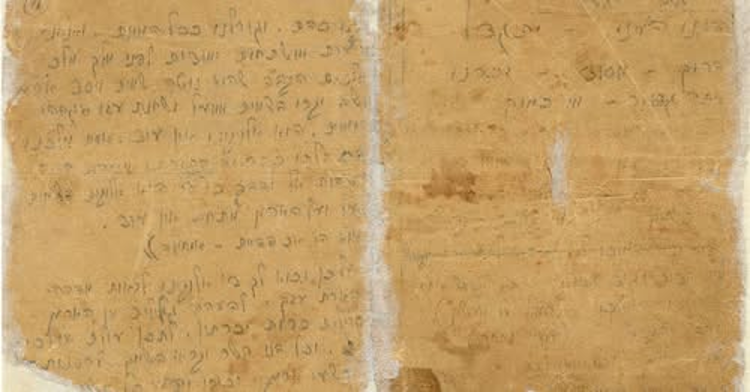
Rosh Hashanah in 1944 started on 17 September. Two days earlier, Rabbi Naftali Stern finished writing out the Rosh Hashanah service. He was a Hungarian Jewish prisoner in the Wolfsberg forced-labour camp, and before arrest had been a cantor in Satu Mare, Romania. He wrote it from memory, using a pencil stub and writing on scraps torn from bags of cement he had ‘bought’ with bread rations. He did indeed succeed in leading a Rosh Hashanah service in the camp.
https://www.yadvashem.org/blog/rosh-hashanah-1944-prayers-on-a-paper-sack.html
G2G Upcoming Events
Thursday 8 October 19:00-20:00 (online)
Lessons Across Generations: Displacement & Housing Insecurity
A joint G2G and Rene Cassin event: ‘Human Rights Through the Generations’. Featuring G2G speaker Jacqueline Luck, this is an in-depth exploration of forced displacement experienced by millions during the Second World War. Click here to book

Remembering Lesley Urbach
A beautiful obituary of Lesley appeared in The Guardian’s ‘Other Lives’ series on Tuesday 18 August. You can find it here:
https://www.theguardian.com/world/2026/aug/18/lesley-urbach-obituary

Features
Her freedom was short-lived – Margot escapes Nazi terror but is arrested in Britain
Diana Cook
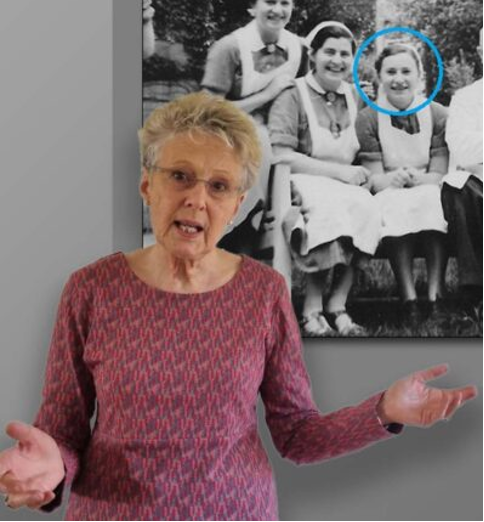
Early in May 1940, after France fell and Hitler invaded Norway, Britain was consumed with panic, genuinely expecting invasion. The government feared a fifth column of enemy loyalists among German, Austrian and Italian people living in this country, so Churchill issued the order: ‘Collar the lot.’
A mass round-up of ‘enemy aliens’ followed, regardless of political allegiance, with most of them being sent to internment camps. My mother Margot had escaped the horrors of Nazi Germany just a few months before and had started work as a student nurse in Leeds. She attended a tribunal where she was asked if she wanted to help Britain during the war, to which she replied, in hesitant English, ‘Of course, but I think working in hospital is the best way of how I can help’. Despite this answer, she was classed B (‘doubtful loyalty’) in common with many other genuine asylum seekers in Leeds, where tribunals are now known to have taken a particularly harsh stance.
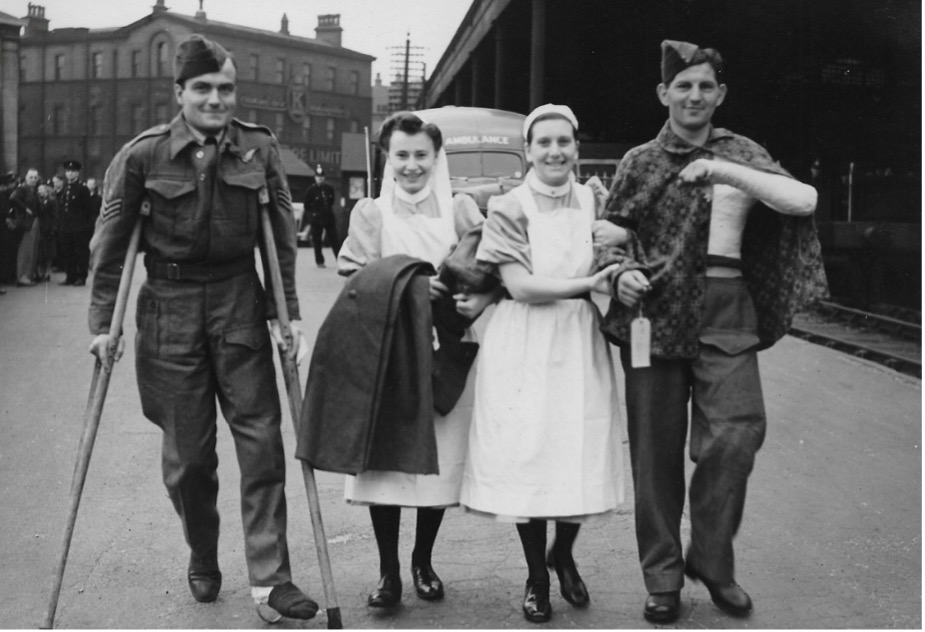
For Margot, this meant a knock on her door in the nurses’ home at seven o’clock on a May morning, by Matron accompanied by a policewoman. She was taken in the back of a police car, with police on either side of her. She was terrified, thinking she was about to be deported to Germany. Margot wrote in her memoir:
‘We stopped at the Leeds Town Hall. There I found a multitude of people, among them my very elderly friends, most of them very distressed. Frankly, I was horrified to think that after what most of us had experienced in Germany we should be thought of as a danger to Britain, it seemed ludicrous. What could the authorities have been thinking of? I saw the two Alien officers, Detective Sergeant Watson and Detective Inspector Medley; my two friends from the Aliens’ office [where Margot had to sign in weekly] were there supervising the proceedings. I went up to them and said, “You know me, how can you think I would do anything against this country?”’
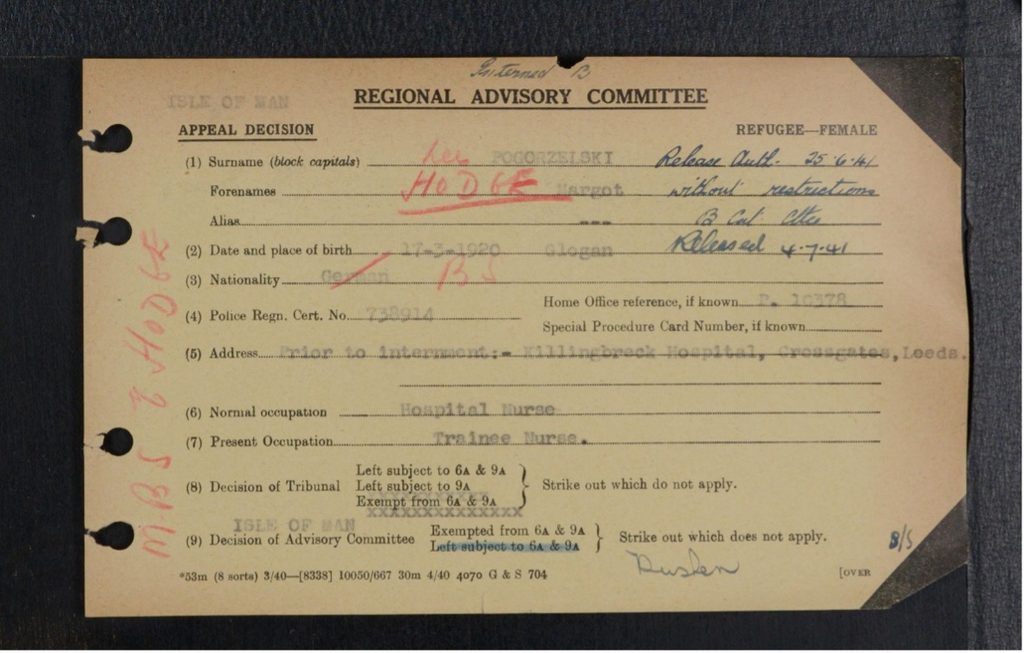
But she was just one of many hundreds of women and children who were eventually bundled onto buses and taken initially to Liverpool. Around 3,500 women and children were interned in just a couple of days at the end of May 1940. Margot explained how it happened:
‘Eventually we arrived at what looked like a huge stadium. We sat on wooden benches all night, how long I can’t remember, but in the early hours we were marched to the nearby docks and boarded a ship, which was some sort of cargo vessel, decrepit and dirty and certainly not enough room for the multitude of women. I found a space on the floor near the door to a toilet – not very salubrious. Until our arrival in Douglas we had no idea where we were going. We then boarded a train which took us to Port Erin. After feeling dirty, tired and hungry it was such a relief to see that beautiful resort’.
People loyal to Britain were treated in the same way as Britain’s enemies. Imagine the arguments, the stone throwing and the verbal abuse when Jewish women were expected to share rooms and dining tables and to work with Nazi sympathisers. Eventually, the two factions were separated, as officials realised it was impossible to keep the peace otherwise.
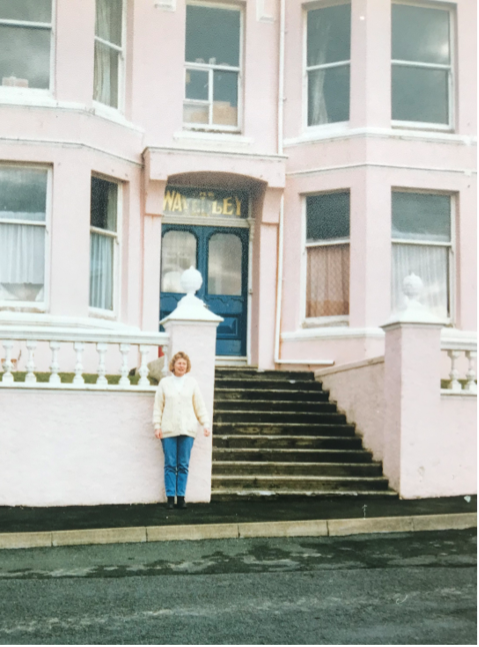
Most women were housed in requisitioned hotels just as asylum seekers are today. They were all fed regularly, given work to do, and generally treated fairly, but no radios or newspapers were allowed, and so boredom was widespread, rumours were rife, and there was constant fear of being sent back to Germany. Margot wrote:
‘The landlady and her daughter ran the hotel and instructed us on the work we had to do. A rota was drawn up, and we took it in turns to clean vegetables, help with the cooking, wait at tables and wash dishes. We also helped with the washing and ironing of clothes, bedlinen and table linen. As there were about 35–40 people living in the hotel, it didn’t take all day to do those chores. At first we were allowed to walk up to Bradda Head or over to Port St Mary, but as time went on the barbed wire was brought nearer and our walks were curtailed.
‘Altogether we did not have enough to do, so when a hospital was established, I was keen to volunteer and was delighted to be accepted. The need for a hospital for the internees came about, because in the haste with which the whole programme of internment was conceived brought about the fact that some of the internees were ill and needed treatment, some women were pregnant and needed monitoring. I was very glad to have this job, partly because it brought me in contact with like-minded people and it helped me to continue with my chosen career.’
The women had no money, and so an internee who had written a university thesis on barter systems put her academic knowledge to practical use. Points were awarded for articles and services that you might need, or make use of, such as some knitting or sewing, English lessons or translation, hairdressing, toothpaste or soap. Points were written on the back of cards made from cereal boxes.
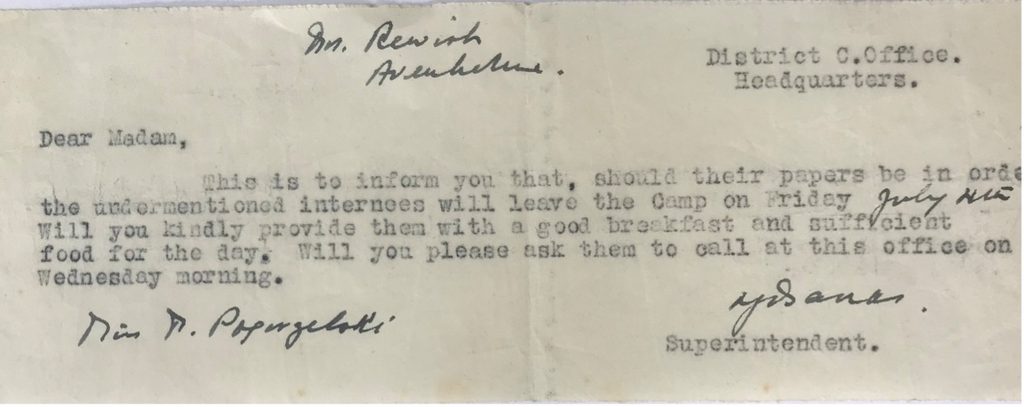
Surprisingly perhaps, Margot remembered her time on the Isle of Man fondly and always hankered after returning. She was never bitter about internment; on the contrary, when Britain stood alone against an enemy, whose ruthless subjugation of other countries made it necessary to round up any suspicious characters, she felt that the internment of potential enemy aliens was justified. She did however concede I may have had a point when I suggested that had Hitler successfully invaded Britain, none of the thousands of Jews on the Isle of Man would have stood the slightest chance of survival.
Fifteen months after being arrested, Margot was released and made her way back to St James’s Hospital. She had to restart her nursing studies, but her English was much improved, and she passed her final exams with flying colours.
References:
- Friend or Foe? The story of women’s internment during WW2, Rushen Heritage Trust 2018, £18.95
- *Mapping the German and Austrian population in Great Britain at the outbreak of the Second World War, Rachel Pistol, EHRI blog 2024
Diana Cook is a G2G presenter who speaks about her mother, Margot Hodge née Pogorzelski.
Partner Events
Association of Jewish Refugees (AJR)
Thursday 24 September 13:00 (in-building at the Imperial War Museum)
Beauty and Destruction: Wartime London in Art
A special opportunity to explore how artists documented London’s resilience and vulnerability during the Second World War. An exclusive curator-led introduction, followed by a flexible, self-paced tour of the exhibition. Tickets free. Click here to book
6 October 12:00-Wednesday 7 October 17:00, Holocaust Centre North, University of Huddersfield
Remembering and Rethinking 2026: Convening the Sector
Following on from last year’s conference, a forum for all those involved in Holocaust education and remembrance. Registration fee £25. Click here to book
Sunday 4 April-Thursday 8 April 2027
AJR Heritage Trip to Slovakia
A unique opportunity to join other descendants for a four-night heritage tour of Slovakia. Using Bratislava as a base, the trip will also visit Zilina, Sered and Nitra. Email nextgens@ajr.org.uk for full information.
Insiders/Outsiders
Wednesday 9 September 09:15-20:15 at St John’s Church 73 Waterloo Road, London SE1 8TY
A Tonic to the Nation:
Refugees and Immigrants at the Festival of Britain
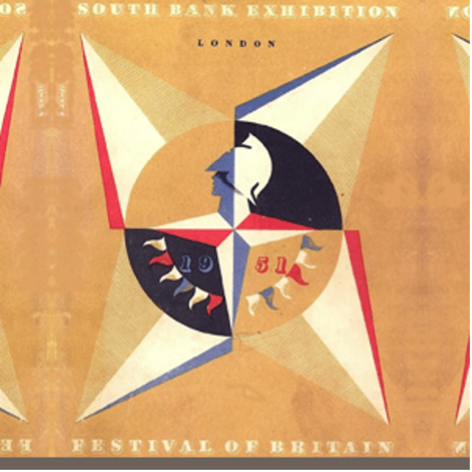
Scheduled to coincide with the 75th anniversary of the Festival of Britain, this one-day symposium will explore the disproportionately large creative input of those from (mostly) Jewish immigrant families and of former refugees from Nazism – many of them imprisoned behind barbed wire as so-called ‘enemy aliens’ only eleven years earlier. The day ends with a cabaret concert that can be booked separately.
Exhibition: Music, Migration and Mobility – The Story of Émigré Musicians from Nazi Europe in Britain runs from 9 September until 9 October. Tickets £12-£45.
For further information about the exhibition click here, and the cabaret concert click here.
Wiener Holocaust Library
Exhibition
Until 30 October
Nazi Slave Labour: Perpetrators and Victims
Between 1939 and 1945, twenty million individuals were exploited as slave and forced labourers by the Nazi regime. This exhibition will explore how perpetrators profited off and exploited slave labourers, alongside the first-hand stories of the victims. Free. For more information click here
Events
Tuesday 8 September 18:30-20:00 (in building)
Book launch and special exhibition –
Dress in Auschwitz: Clothing and Survival in the Holocaust, with Sofia Pantouvaki
Sofia Pantouvaki’s new book explores the experience of Auschwitz prisoners through the lens of dress and clothing and examines the profound importance of clothing to prisoners’ physical and emotional survival. Tickets free. Click here to book
Tuesday 22 September,17:00-18:00 (in building and online)
Hybrid event: Launch of the Jewish Historical Society of England Oral History Archive by Alan Dein and Madeline White
Oral historian and broadcaster Alan Dein will be discussing the interviews he has recorded for the JHSE Oral History Project. Alan’s colleague, Madeline White who is Curator of Oral History and Deputy Director of National Life Stories at the British Library will then talk about the oral history collection at the British Library where the JHSE archive will be held. Tickets free. Click here to book
18:15-19:30 (In building and online)
Hybrid event: JHSE Roundtable Discussion – Contemporary Antisemitism: Historical Lessons
In this roundtable discussion, JHSE President Professor Gavin Schaffer will be joined by Professors Miri Rubin and Tony Kushner to discuss the relationship between present-day and historical antisemitism in Britain. Tickets free. Click here to book
Thursday 24 September 10:00-11:30 (online)
Online Book Talk in cooperation with the Melbourne Holocaust Museum –
Irmgard: The Girl from Dresden: A Memoir of Survival and Legacy
Fiona Kelman in conversation with Dr Simon Holloway. Tickets free. Click here to book
Have you enjoyed our Newsletter? Please consider making a donation to our charity.
Your donations help us to keep experiences of the Holocaust alive and teach younger generations the importance of inclusivity and empathy. You can donate to support our ongoing work in the following areas:
- Speaker development and training
- Technical support for our speakers
- Creation and writing of educational materials
- Provision of Holocaust speakers for schools and other organisations
- Raising awareness of our work and our message.