
Newsletter for Generation 2 Generation

November 2026 | Tishri – Heshvan 5787
We deeply appreciate your support. Please share this newsletter with those who believe in our mission of Holocaust education and remembrance. Your efforts help us ensure that the lessons of history are never forgotten. Thank you.
Has this newsletter been forwarded to you? You can sign up by clicking here.
Editorial
Almost exactly 89 years ago, on 8 November 1937, Josef Goebbels, Reich propaganda minister, and Julius Streicher, editor of Der Stürmer (‘The Attacker’) opened the antisemitic exhibition Der Ewige Jude (‘The Eternal Jew’) in the Munich German Museum. It showed photographs and caricatures intended to falsely accuse Jews of undermining Nazi Germany. It was visited by around 400,000 people.
Conversely, the Degenerate Art (Entartete Kunst) exhibition, which had opened in Munich four months earlier, displayed 650 works of art confiscated from German museums. One million people attended the free exhibition in its first six weeks, taking the opportunity to see – and admire – such a vast collection of world-class art. It had the opposite effect from that intended by the Nazi party.
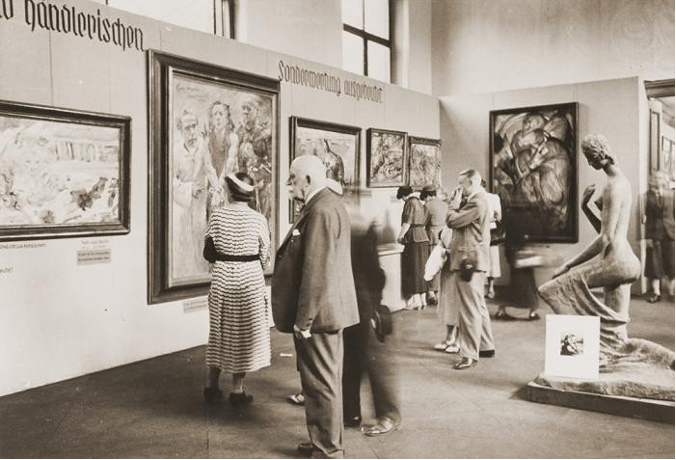
The existence of these two, very different, exhibitions, remind us just how powerful the visual arts are, for both artist and viewer.
These exhibitions demonstrate how visual art may be used for evil or for good. Since the War, some artists have used this medium to process the after-effects of the Shoah. In this edition, we have two reflections on how second-generation artists have dealt with the impact of the Holocaust – one by art historian Monica Bohm-Duchen and one by artist Joan Noble.
Vivienne Cato
G2G Upcoming Events
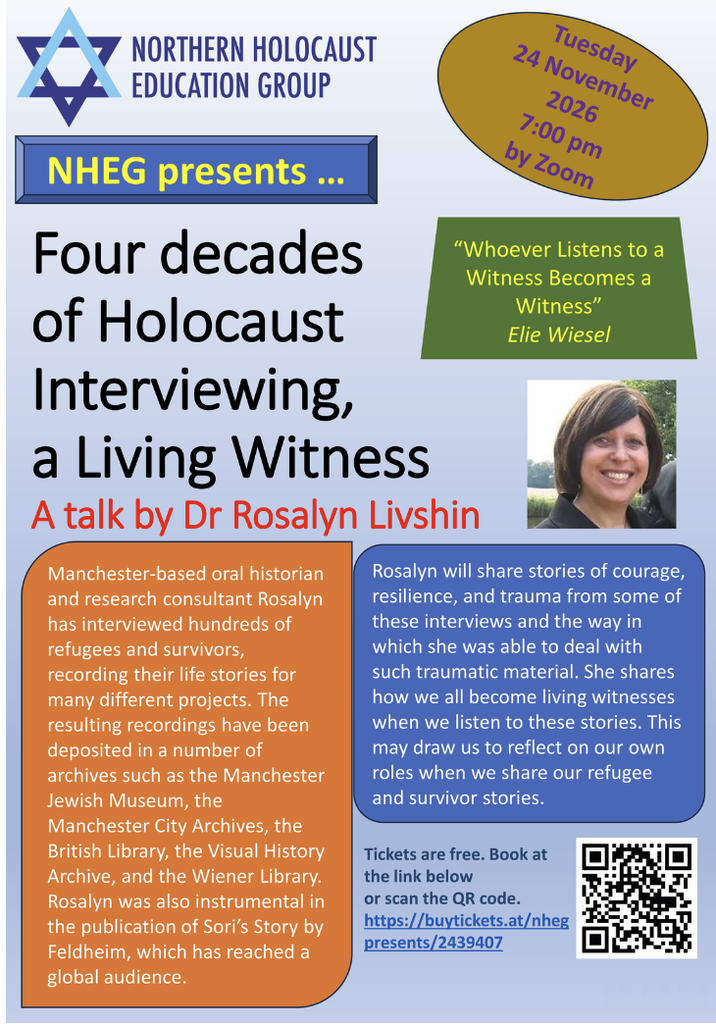
Tuesday 24 November 19:00 (online)
NHEG Presents: Four Decades of Holocaust Interviewing, a Living Witness. A talk by Rosalyn Livshin
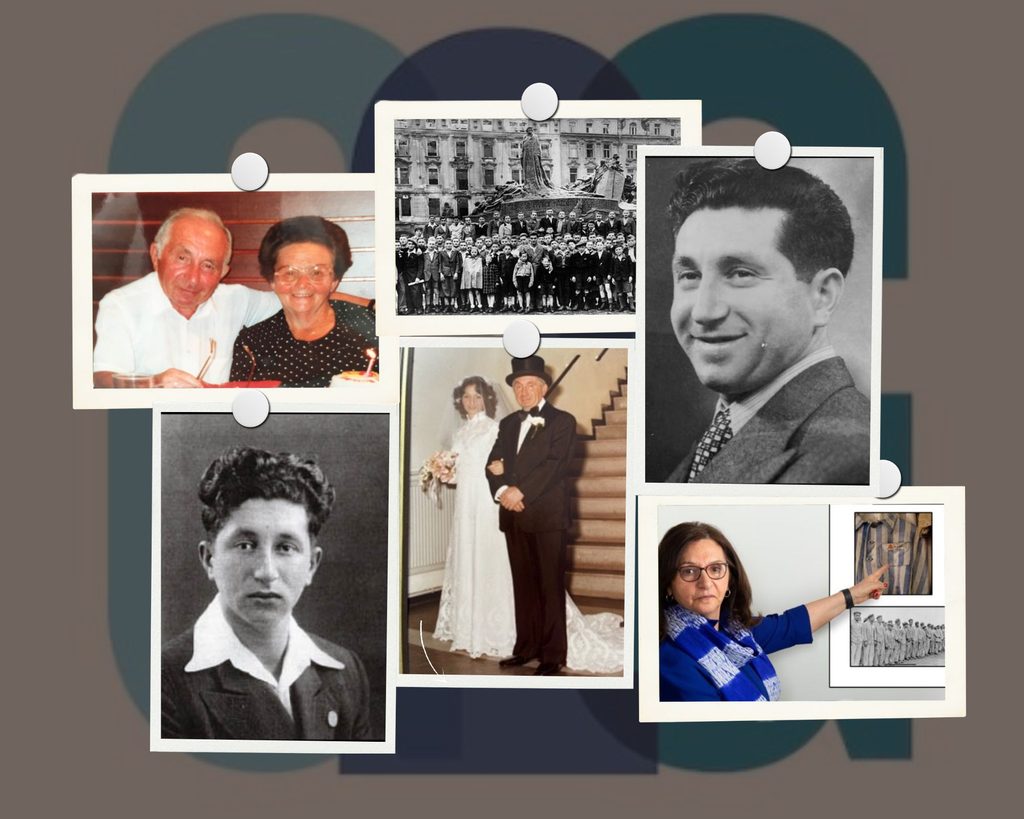
Wednesday, 11th Nov, 19:00- 20:30, Chipping Barnet Library
G2G Presents: The Story of Sam Gardner
Learn about the extraordinary story of Sam Gardner narrated by his daughter Maralyn Turgel. Free
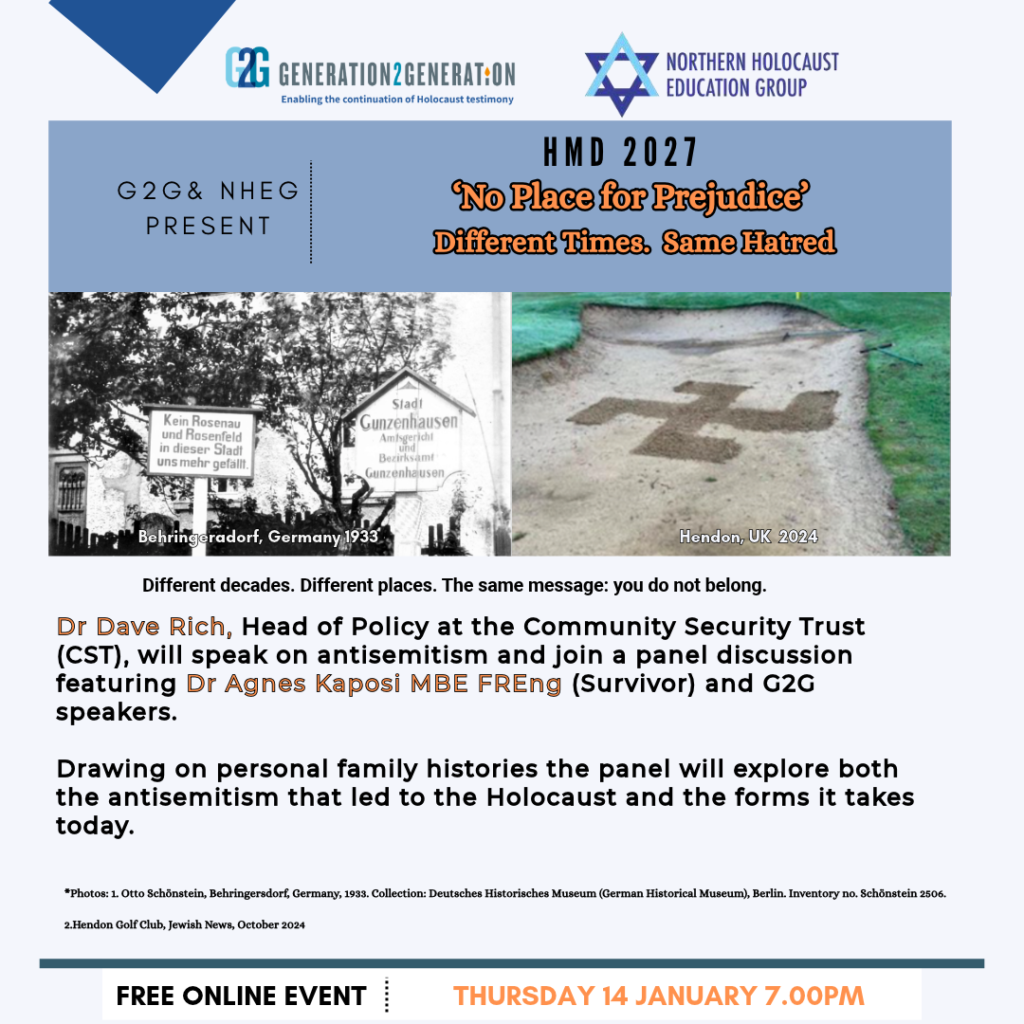
G2G–NHEG Holocaust Memorial Day 2027
No Place for Prejudice’. Different Times. Same Hatred.
Free. Online
Save the Date
Tuesday 26th January 2027 19.30, OSO Theatre, Barnes
G2G Presents: Testimonies from the Holocaust
Join us for unforgettable and moving testimony, featuring:
- Eva Clarke, one of the youngest camp survivors
- Gerry Hahlo, whose father escaped on the Kindertransport
- Andrew Winter playing a violin used in the Terezin camp
- Anita Peleg, whose mother expressed her experiences through sculpture.
https://www.yadvashem.org/blog/rosh-hashanah-1944-prayers-on-a-paper-sack.html
Features
‘Not About but After’:
Second Generation Jewish Artists in the UK
Monica Bohm-Duchen
As readers of this article will be all very much well aware, the generation which experienced the profound upheavals and traumas of the rise of Fascism, the Second World War and the Holocaust at firsthand is on the cusp of disappearing, and the compulsion felt by so many of their offspring to ensure that those experiences are not forgotten has become ever more urgent. As artist Ardyn Halter, son of survivor artist Roman Halter, has written so eloquently, ‘The lives of the murdered cry out against the convenience of oblivion… This is a baton, the survivor says to his children. And in tacit agreement that such a baton can indeed be handed on, they come to be called the Second Generation. This becomes their burden, whether willingly borne or thrust upon them, but intolerable. Necessary, but impossible.’
The need to acknowledge and explore the distinctive needs of those whom Helen Epstein dubbed the ‘Children of the Holocaust’ when setting out to find ‘a group of people who, like me, were possessed by a history they had never lived’ dates back to the mid-1970s. A more detailed academic scrutiny of the phenomenon now most commonly known as the ‘Second Generation’ (but also the ‘hinge generation ‘and the ‘generation after’) and the concomitant concept of ‘postmemory’ (as well as the related concepts of ‘vicarious memory’,‘mémoire trouée’, ‘rememory’ and ‘prosthetic memory’) gathered momentum in the 1990s, with 1995 as the fiftieth anniversary of the end of the Second World War acting as a symbolic and psychological watershed – and shows little sign of abating. Indeed, although it is too early to make any judgements on the matter, there is growing evidence that some artist members of the ‘Third Generation’ are also rising to the challenge of engaging creatively with difficult family pasts.
Marianne Hirsch, who first coined the hugely influential term ‘postmemory’ in the early 1990s, has been exploring the concept ever since, and in 2012 defined it as follows: ‘In my reading, postmemory is distinguished from memory by generational distance and from history by deep personal connection. Postmemory is a powerful and very particular form of memory precisely because its connection to its object or source is mediated not through recollection but through an imaginative investment and creation.’ And Ardyn Halter puts it even more concisely when he writes of ‘the cuckoo of another’s memory within your nest.’
The creative responses of visual artists to their families’ complicated and traumatic histories, however, have been distinctly neglected – and when they have been examined in any detail, the focus has tended to be on artists working in the USA. In Israel, where the topic of the Holocaust, in art and society alike, remained almost a taboo for many decades, scholarly attention has only relatively recently begun to focus on those visual artists who have grappled with its legacy.
In other words, the work of Second Generation Jewish artists working in the UK – most of them, for historical reasons, the children of refugees from Nazism rather than Holocaust survivors – remains relatively uncharted territory. While I – like many others – baulk at the application without distinction of the term ‘survivor’ to both these First Generation groups, there is no doubt that the Holocaust lies at the dark heart of the artworks produced by the descendants of both groups. And few, if any of them, would, I think, disagree with French-born, half-Jewish artist Christian Boltanski’s statement that ‘My work is not about, it is after’.
Notwithstanding the wide range of artistic styles and media employed by these UK-based artists and the differing levels of explicitness in their terms of reference and engagement with the theoretical field of memory studies, as well as the fact that their birthdates range from the 1940s to the 1970s and that not all the artists are fully Jewish, the preoccupations they share are remarkably consistent. Thus, when Lorna Brunstein describes her work as embodying ‘an emotional archaeology in which traces, fragments and memories are the starting point’, she could well be speaking for all of them.
Pre-war family photographs, nearly always few in number and which often only come to light after a relative’s death, exercise a particular, almost talismanic fascination. Photographs, often taken in the present by the artists themselves, of locations associated with their parents’ pre-war and wartime lives are another recurring preoccupation. Again and again, a recourse to photographs helps counter the overwhelming silences about a traumatic past so prevalent in the families of survivors and refugees. As Hirsch puts it so eloquently, ‘Photographs in their enduring ‘umbilical’ connection to life are precisely the medium connecting first- and second-generation remembrance, memory and postmemory. ’ … ‘Photography’s relation to loss and death is … to bring the past back in the form of a ghostly revenant, emphasising, at the same time, its immutable and irreversible pastness and irretrievability.’
And then, since a disproportionate number of the artists are female, there is the issue of gender. The reasons for this may well include the peculiar intimacy (not necessarily desired) of the mother and daughter dyad; the woman as bearer both of children and memory; the related fact that it is the matriarchal line which determines whether a child is halakhically Jewish and the perception of the domestic sphere as a poignant microcosm of the wider world. Once again, Hirsch provides food for thought: ‘Feminist approaches allow me to bring the entangled strands of disparate traumatic histories into more intimate contact.’
I myself would go further and argue that it is not just feminism that can act as a spur, but the creative act itself, which enables artists not only to work through their complex emotions in relation to their family pasts but through their artworks to communicate those emotions to others, so that ‘familial postmemory’ morphs into what has been termed ‘affiliative memory’. As the late Judith Tucker put it, ‘In a way, there is a paradox here for those of us who are second-generation artists: the overwhelming nature of the traumatic events can simultaneously overshadow and stimulate a search to articulate our own experience.’ We might recall too Lily Markiewicz’s claim that ‘to make art is to “make home”‘, and the comment made about Barbara Loftus that for her ‘ “home” is the in-between space of the studio, where an identity can be given form’.
Last but by no means least, it is striking how many of these artists have felt compelled to engage with different traumatic pasts (among them slavery and the Rwandan and Bosnian genocides), aware and intent on making others aware that (in keeping with Michael Rothberg’s important concept of ‘multidirectional memory’) there should never be a hierarchy of suffering. Also noteworthy is the way so many of them view their engagement with their own family histories as a natural path towards empathy and solidarity with migrants, refugees and survivors of atrocities in the ever more troubling present.
Monica Bohm-Duchen is a London-based art historian with a longstanding interest in issues of Jewish identity in modern art, and the founding director of Insiders/Outsiders, an ongoing celebration of the contribution of refugees from Nazi Europe to British culture.
This text has been adapted from a longer essay which appeared in the 2021 Age of Confidence: The New Culture Wave: Celebrating Twenty Years of Jewish Renaissance anthology (see Age of Confidence: The New Jewish Culture Wave: Celebrating Twenty Years of Jewish Renaissance eBook : Benmayer, David, Taylor, Rebecca, Jacobson, Howard: Amazon.co.uk: Books ).
My Art Journey
Joan Noble
Many years ago I failed ‘A’ Level Art, which for years totally stifled my creativity. I began my career as a Home Economics teacher, which later fortuitously led me into a speciality career as a home economist in the gluten-free industry. It all began with making a gluten-free birthday cake and culminated in becoming a director and product developer with a fulfilling 15-year career.
When that ended I changed direction and worked at the Holocaust Survivor Centre, which gave me the unique privilege of meeting the most amazing and interesting people. I was responsible for the programme of events at the Centre in Hendon and this included the audio testimony recordings for the National Archives. That was before the Stephen Spielberg Foundation became established in the UK. It was really then that I became more aware of my own family story and started to take a more positive interest in my heritage.
My family originated from Germany, and I grew up knowing that I had no grandparents. My mother died aged 47; my father had many documents, letters and photos of his family. I began piecing together my family history and gradually more information became available to me, mainly from a German historian exploring archives in my mother’s hometown of Grevenbroich. The main item of interest we translated was a diary written by my 16-year-old mother in 1933, in which she gives an insightful narrative of her teenage years side by side with history being made.
Years later in retirement I overcame my art ‘phobia’ by attending adult classes which offered many varied techniques. This opened up all the creative possibilities that have now facilitated my career as an artist.
Having experimented with paints and collage on canvas and paper, I began creating through collage, which allowed me to tell a family history in a visual form. It was a very satisfying way to piece together, rather like a jigsaw, my relatives’ lives in one visual form. I also moved into textiles and mixed media.
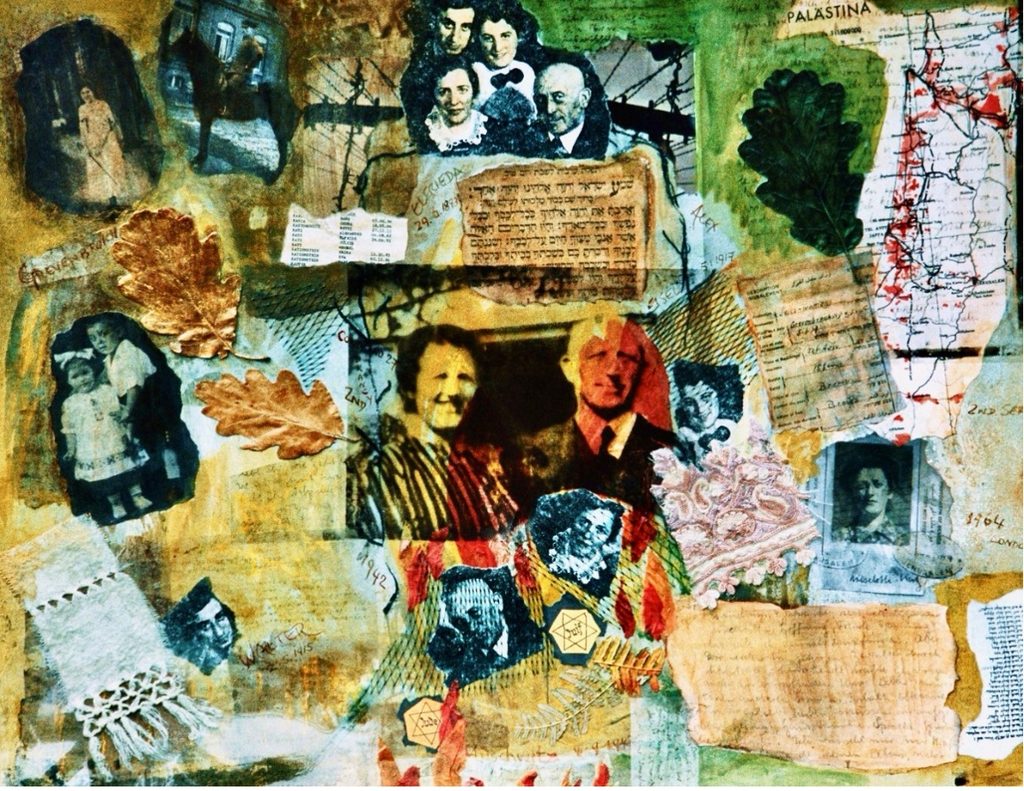
Over the years I have had exhibitions, including a solo show ‘Out of the Shadows’ that dealt with migration, captivity and loss, all born out of my interest in the Shoah.
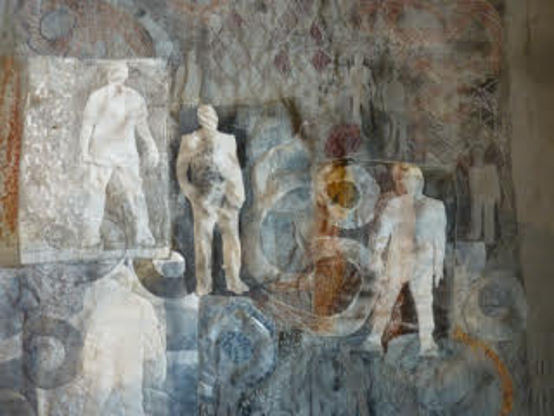
Many people have documents and photos that don’t get much of an airing, whereas a collage hanging on the wall will invite questions from viewers. So in the past I have run workshops across one or two sessions for people to tell their own family history life stories through art.
It is most important to source real documents and photographs but, as these originals are so precious, we only use copies of them. Sometimes these will be stained sepia to give an appearance of age, or torn or scorched at the edges for a more authentic look.
Papers and artifacts need to be selected and are then built up using paint and by layering transparent papers – ultimately providing a cohesive visual result that is pleasing as a hanging or as a booklet to share with the next generations.
I ran a workshop with a diverse group of schoolchildren in Croydon who were studying the Holocaust. After a demonstration and with supporting art materials they were able to produce something very presentable in just a short space of time. Backed up by workshop sessions, they created a display on the Shoah, genocide and the importance of developing the values of diversity, respect and tolerance. The inclusion of art in telling a story adds to the dialogue.
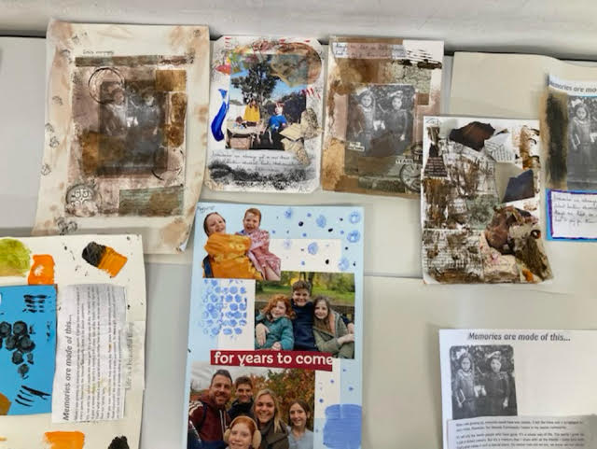
This was all before I embarked on my G2G presentation to tell the story of my mother Liesel and her parents, my grandparents Elfriede and Alex Katz. As part of the talk I show the collages to inspire young people to maybe do something similar. Following three years of planning, my presentation has been well received and is a great heritage for the next generations of my family as well as for Holocaust education.
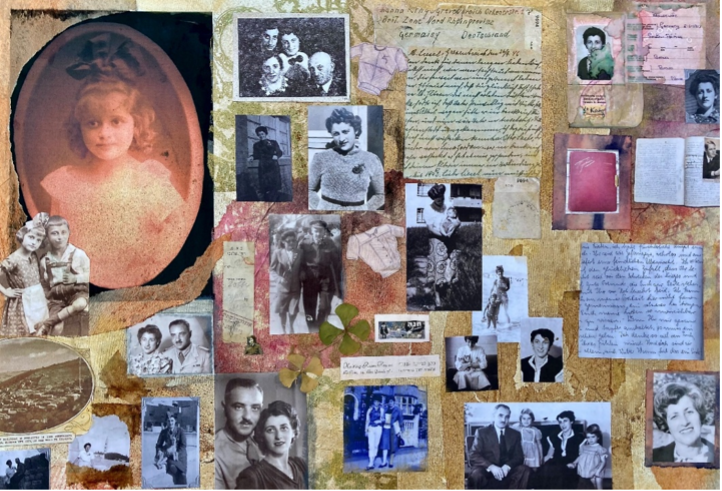
My beautiful home studio overflows with papers, fabrics, threads and all sorts of things that will one day be useful. I have a lifetime of work to get down to and endless ideas I wish to tackle.
Meanwhile I am fully occupied making community textile hangings for the walls in our new synagogue, Mosaic in Stanmore, that relate our Jewish heritage.
Joan Noble presents the story of her mother, Liesel Katz, for Generation 2 Generation Click here for details
Partner Events
Sunday, 17th January 2027 17.00, Hampstead United Synagogue, NW6
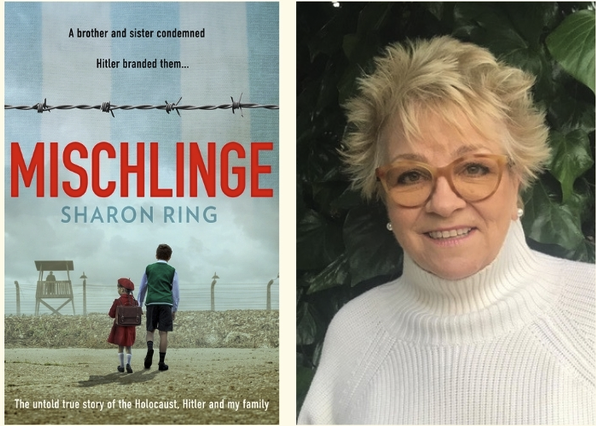
Mishlinge: The 6th Sabina Miller Memorial Lecture
Mishlinge, the German word for mongrel dogs, was applied by the Nazis to people like Edie and Heine when they were just five and nine years old. Sharon Ring tells the story of her mother and uncle in an uplifting testimony. Tickets £5 for members and £7 for non members
To book click here
Association of Jewish Refugees (AJR)
Tuesday 10 November 14:00 northwest London venue
AJR’s Annual Kristallnacht Service 2026
Click here to book
Thursday 12 November 19:00 (northwest London venue)
Book Launch: Uprooted Lives – Obituaries of Refugees and Survivors of the Holocaust from the AJR Journal 1955-2025
Edited by Andrew Kaufman MBE and Dr Bea Lewkowicz OBE, Uprooted Lives tells the extraordinary stories of principally German-speaking Jewish refugees and Holocaust survivors who found sanctuary in Britain.
Click here to book
Sunday 4 April-Thursday 8 April 2027
AJR Heritage Trip to Slovakia
Visiting Bratislava, Žilina, Sereď and Nitra.
Cost (not including flights and meals other than breakfast): £380 for double or twin room, £540 for single room.
Click here to book
JW3
Thursday 5 November 19:00-20:15
Kristallnacht Commemoration: Ausländer
JW3’s annual Kristallnacht commemorative event, which this year centres on Michael Moritz’s Ausländer, a deeply personal exploration of family, flight and inherited memory. Free.
Click here to book
Monday 9 November 19:00–20:15 (in building)
In conversation with Lord Alf Dubs
The legendary Lord Alf Dubs will feature in “JW3 on Kristallnacht (the Night of Broken Glass)” in conversation with Rabbi Jonathan Wittenberg to talk about his life and newly released memoir, The Boy with the Knapsack: An Extraordinary Life, from the Kindertransport to the House of Lords. Tickets £15.
Thursday 26 November 19:00-20:15
People Without History Are Dust: Queer Desire in the Holocaust
Dr Anna Hájková in conversation with Dr Aviva Dautch, discussing the often-overlooked place of queerness in Holocaust history. Tickets £15.
Click here to book
National Holocaust Centre and Museum, Newark
Sunday 22nd November, 2pm-4pm (in person and online)
Poland before the Holocaust – Recovering Traces of Jewish Life
We will be hosting this special event at The National Holocaust Museum and we will be joined live from the Galicia Jewish Museum in Krakow. Learn about the Jewish population in Poland, and explore the Galicia Jewish Museum whilst hearing from it’s curators about the traces of a culture that was almost entirely wiped out.
Second Generation Network (2GN)
Tuesday 8 December
Dialogue across the Divide
Lorenz Hemicker, senior journalist at the Frankfurter Allgemeine Zeitung, in discussion with Nicola Hanefeld, Member of the 2GN Events Committee. Lorenz’s grandfather was an SS officer, a perpetrator with co-responsibility for the murder of thousands of Jews in Rumbula, Riga. Free.
Click here to book
Wiener Holocaust Library
Exhibition
Wednesday 4 November 2026 – Saturday 26 February 2027
J’accuse! Press, Polemic and the Dreyfus Affair
Examining the print culture that emerged in response to the Dreyfus Affair, this exhibition seeks to explain how a relatively ordinary man became caught up in an immense miscarriage of justice, which transformed into one of the first major mass media moments. Free.
Click here to book
Events
Wednesday 4 November 18:00-19:00 (Gresham College, Barnard’s Inn Hall, & online)
Material Witness: Understanding the Objects of Auschwitz
The 2026 Alfred Wiener Holocaust Memorial Lecture, delivered by historian Professor Zoë Waxman, senior research fellow of the Oxford Centre for Hebrew and Jewish Studies. Free.
Click here to book
Thursday 19 November 18:30-20:00 (in building)
Book Talk and Special Exhibition – After Belsen: Christian Encounters with Holocaust Survivors
Dr Rob Thompson in conversation with Professor Shirli Gilbert, discussing the ways in which British and American Christians responded to and were affected by meeting survivors of the Holocaust in the years immediately following the liberation of concentration camps. Free.
Click here to book
Wednesday 25 November 18:00-20:00 (in building)
Book Launch – The Silent City of Drancy: Social Housing and Holocaust Memory on the Margins of Paris
Dr Stephanie Hesz-Wood in conversation with Professor Dan Stone about her new book. Free.
Click here to book
Thursday 26 November 18:30-20:00 (in building)
Book Talk – A Woman Named Edith, by Daria Santini
A Woman Named Edith is Daria Santini’s new biography of Edith Tudor Hart, Austrian photographer and committed communist activist, and the first in English. Free.
Click here to book
Have you enjoyed our Newsletter? Please consider making a donation to our charity.
Your donations help us to keep experiences of the Holocaust alive and teach younger generations the importance of inclusivity and empathy. You can donate to support our ongoing work in the following areas:
- Speaker development and training
- Technical support for our speakers
- Creation and writing of educational materials
- Provision of Holocaust speakers for schools and other organisations
- Raising awareness of our work and our message.