
In Memoriam – Lesley Urbach z”l
May 2026 | Iyar – Sivan 5786
Editorial
We had hoped to end this academic year with uplifting news about G2G’s successes. But since 24 June the situation has changed, with the tragic and untimely death of our co-founder, trustee, bookings officer, mentor and presenter Lesley Urbach z”l (may her memory be a blessing). The very fact that last year was so successful – nudging 500 bookings – was in large part due to her efforts. We devote this issue to her memory, telling the story of her life and that of her German family of origin, the Wohls. Lesley was determined that their story should not die with her. The account given below is an abbreviated version of one she wrote recently, in readiness for what we hope will become a published G2G anthology of presenters’ family stories.
Vivienne Cato
Lesley Urbach z”l –
A Modern Woman of Valour

Fierce, determined, direct, hard-working, principled, selfless, energetic, feisty, impatient, creative, friendly, kind and compassionate with a sparkling smile.
These are just a few of the words used by G2G speakers and volunteers to describe
Lesley Urbach z”l (Zichrona L’vracha – May her memory be a blessing), our co-founder, associate director and friend, who collapsed suddenly at a meeting on 19 July and passed away five days later in Harefield Hospital.
More than 250 people paid tribute to her at Edgwarebury Lane Cemetery on 2 July and at the shiva (Jewish mourning event) that evening, a testament to her popularity and her achievements. At G2G we already knew that she was the heartbeat of the organisation, but at the cemetery we discovered how vital she was to so many communities and how her drive led her to accomplish so much.
Her passion was history, which led her as a young woman to take a BA at UCL and, post-retirement, a MRes in Jewish History and Culture at Southampton University. For her dissertation topic she chose Eleanor Rathbone MP, a campaigner for women’s rights and for refugees – especially Jewish refugees to the UK in the 1930s. Later she co-founded the Remembering Eleanor Rathbone Group, an organisation to spread awareness of Eleanor Rathbone’s contribution to society and the causes she championed.
Over Lesley’s life she was an important and very active member of two Jewish communities, Beit Klal Yisrael and Finchley Progressive Synagogue. In neither did she shy away from taking the lead on projects, particularly those connected with refugee welfare and support. At FPS she was on the Council, co-editor of the Newsletter, and leader of the Welfare Group. She was heavily involved in the synagogue becoming a Synagogue of Sanctuary, of which she was most proud.
As co-founder, associate director and trustee of G2G she shaped the organisation, emphasising the importance of highly professional, historically accurate and engaging presentations. She led the speaker development team, ensuring that our speakers were provided with mentors and training. She herself was mentor to a goodly number of our excellent speakers, who all speak highly of her and appreciate how she pushed them beyond their comfort zone to continuously improve and be the very best that they could be. Above all, she led the bookings team, managing the enormous task of liaising between schools or other host institutions and our speakers. Indeed, this academic year (2025-2026) she took pride in G2G having brought in more than 500 bookings. She did that with great care and exactness, carefully matching each client with the most appropriate speaker. It was a huge and demanding task, much valued by those making bookings through her, for whom she became a familiar and welcoming friend.
As if this was all not enough, Lesley was constantly creating new initiatives. She pioneered G2G Presents, a series of monthly online events to showcase G2G’s work and to discuss issues of contemporary relevance. This ongoing series ensures that we not only remember key Holocaust stories but also try to understand current crises such as those concerning the Tutsis, the Uyghurs and the Sudanese people. As part of G2G Presents, she created two important collaborations: one with René Cassin, the Jewish human rights organisation, and the other with HIAS+JCORE, which supports refugees in the light of Jewish ethics. These collaborations will continue, as part of Lesley’s legacy.
It is not easy to sum up the personal qualities that made all these many achievements possible. Lesley was never complacent. She was always pushing the boundaries, combining a great sense of urgency and a can-do, optimistic attitude. For Lesley everything was achievable if we all only buckled down and made the effort. But on top of this, it was her charm, her sense of humour, and her at times frank directness that made it possible for her to carry all this through. Probably all 250 people at her funeral and shiva felt she had been their especial friend. This is no small gift. Her colourful and confident way of dressing, her love of a charity shop bargain, her enjoyment of days out at the seaside: Lesley achieved what she did by being quirky and fun, as well as seriously committed to her vision of a better world.
There are countless people who will miss her, as an initiator, an organiser, a colleague, an inspiration and a friend. I know that all of us at G2G will aspire to continue her legacy in her honour, and to cherish her memory.
May her memory be for a blessing.
Anita Peleg, G2G Director
The Wohl family story: Echoes through the Generations
Lesley Urbach

My mother, Eva Wohl, was born on 9 December 1922 in Bublitz, a small market town which was then part of Pomerania, Prussia. The Wohl family had lived there since the 1840s.
My grandfather, Leonhard Wohl, was born in 1886, one of ten children. His first wife was Erna Margoniner. They were married in about 1910 and had two daughters – Ilse, born in 1911, and Käte, 1919. Erna died soon after Käte’s birth.

Widower Leonhard then remarried. His new wife, my grandmother, was Clara Jacobi, a young teacher from the nearby town of Naugard. Between them they created what we know was a loving, warm home for their family. My aunt Ursula (‘Ulli’) was born in 1925, three years after my mother Eva. Clara raised Käte as her own daughter, while Ilse lived with Clara’s mother, Flora, in the seaside town of Kolberg.
The family were proud to be German and, as Ilse recalled, patriotism was instilled in them all. My grandfather was amongst the 100,000 or so German Jews who fought for their country in the First World War, earning him the Iron Cross.
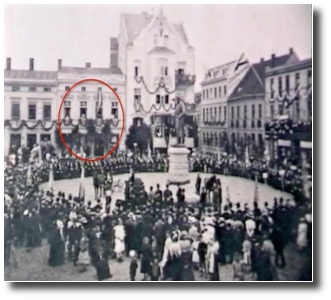
After the war, Leonhard and his brother Alex continued to run the family business, M. Wohl, which their grandfather, Moses Wohl, had founded, trading in agricultural produce. It was, by all accounts, a close family circle, bound together by work, love and tradition.
My mother and aunts remembered those early years as idyllic. Life for them revolved around the family and their Jewish life.
The sisters attended the local school and played with non-Jewish friends. Kolberg was, in my mother’s mind, a place of dazzling white sands and carefree joy, while Ulli later described those summers simply as ‘Heaven’.
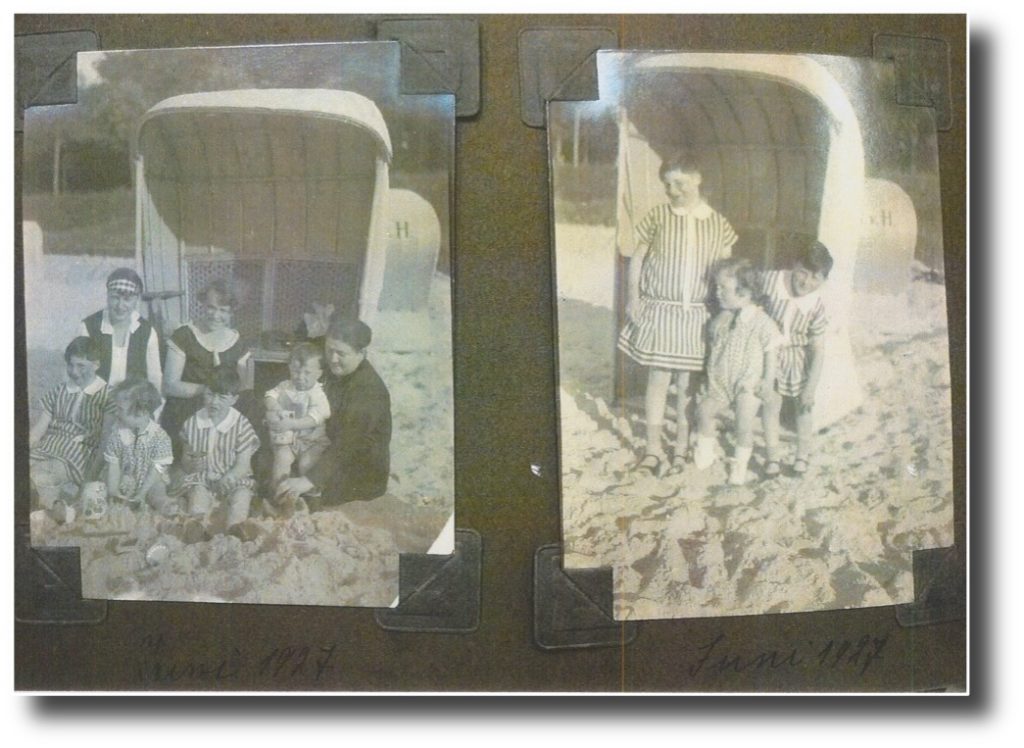
The girls’ father Leonhard had a cheerful and mischievous nature. Clara was more serious, practical, disciplined, and the guardian of good manners and household order. It was a happy childhood full of warmth and security.
My mother was only ten years old when Hitler was sworn in as Chancellor of Germany on 30 January 1933; it was a day that she never forgot. One of my mother’s abiding recollections of this time was that ‘people who we were friendly with turned against us overnight.’
As part of the nationwide boycott of German Jewish businesses introduced on 1 April the Nazis placed guards outside the Jewish-owned shops in Bublitz, holding placards declaring ‘The Jews are our misfortune.’ One such guard was stationed outside the family shop. It happened that my grandfather knew him, and he kindly and probably with some irony offered the fellow a chair to sit on. The response from a senior Nazi officer was terrifying. He stormed into the shop and screamed at my grandfather, threatening that if he did anything like that ever again he would make sure that ‘his Jewish blood will spurt up to the heavens.’ After the Nuremberg Laws of September 1935, the family business collapsed.
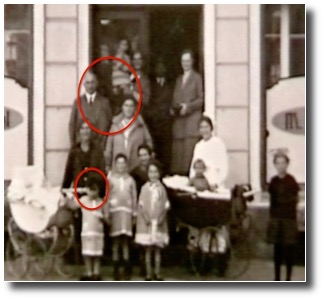
The Wohl family business
By 1937 life in Bublitz had become unbearable. Eva was 14 when she left for Berlin to attend a Jewish commercial school, while Käte went into domestic service somewhere in southern Germany.
Eleven-year-old Ulli remained in Bublitz, the last Jewish child in the town, and she recalled that she ‘had no one to play with … I was terribly lonely.’ That same year Leonhard and Alex were forced to sell the business, and she witnessed her father crying as he lowered the shutters for the final time. His poem, written soon after, ends: ‘Those beautiful times… are over, over, over.’
In early 1938 my grandparents and Ulli moved to Berlin to join my mother. Leonhard wrote to a brother: ‘It is a bitter decision, not voluntary, but hard necessity is forcing us to leave Bublitz.’
Urban life offered a degree of anonymity. But during the November Pogrom (‘Kristallnacht’) of 9–10 November 1938, Leonhard and his brother Oscar were arrested in Potsdam whilst visiting another brother. Leonhard was held in a local police station. One of the policemen turned out to be a comrade of his from the war. Despite this, the man publicly mistreated my grandfather in front of the others. But he apologised privately when they were alone. Oscar was taken to Dachau. On his return, Ulli remembered, he was ‘almost unrecognisable… as if his clothes had been dipped in acid.’
The pogrom shattered any remaining illusions my grandparents may have had, and they knew then that there was no future for Jews in Germany. And they made the most painful decision of their lives. They managed to secure places on a Kindertransport for Eva and Ulli.
On 14 December 1938, five days after Eva’s 16th birthday, my mother and 13-year-old Ulli boarded the train at a small Berlin station the Nazi authorities had chosen in order to minimise attention. My grandparents were barely able to speak for weeping as they bade farewell to their two daughters. It was the last time they would ever see them. Before they left, their older sister, Käte, only 19, told them: ‘Whatever happens, don’t write home and tell them how difficult things are. They can’t help you. Just say everything is nice.’
The ship carrying Eva and Ulli and many other children docked at Harwich in Essex on 15 December 1938. They were taken from there to Dovercourt Holiday Camp, which was closed to holidaymakers for the winter, and at the start of 1939 they were moved to Wyberlye Ladies Convalescent Home in Burgess Hill.
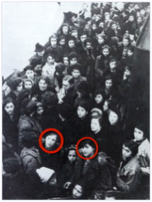
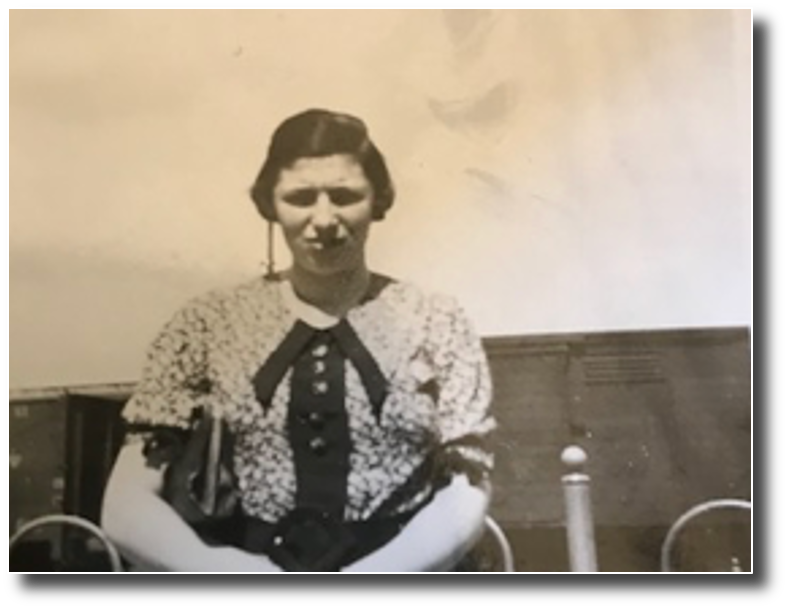
The letters from my grandparents during this time are full of longing. ‘My thoughts are only with you… How we can be together again as quickly as possible? …We had to part from our little children, which brought us untold suffering.’
Eva’s parents did everything they could to escape Germany. Eventually they acquired visas for Chile and began the process of securing visas for their daughters. But the war broke out and they were unable to leave when they hoped to, and their visas expired.
The girls gathered around the radio at Wyberlye at 11am on 3 September 1939, and heard the Prime Minister, Neville Chamberlain, announce that war had been declared against Germany. In that moment my mother knew instinctively that ‘we wouldn’t see our parents again’.
Once war began, girls over sixteen had to leave Burgess Hill, as the area became restricted. Eva and Ulli both worked in a factory making uniforms for the British Army. There, on day one, my mother met her husband-to-be, my father, Arnold Urbach, another Jewish refugee from Germany. He and Eva married in July 1943, and my brother Peter was born on 3 October 1944.
Leonhard and Clara managed to gain visas for Ecuador and the Dominican Republic, and trunks of personal belongings were shipped ahead. But the war closed routes, ships were cancelled and borders shut.
At some point my grandparents were forced into factory labour, and on 23 October 1941 any hopes of escape were finally shattered as Jews were forbidden to leave the German Reich. On 19 February 1943, they were deported to Auschwitz and murdered the day after they arrived. Clara was 48 and Leonhard 59.
My parents had three more children, two of whom predeceased them. The family line continues only through Ilse’s grandchildren and great-grandchildren.
Reflecting, in her testimony, on her parents’ decision to send her away, my mother said quietly, ‘Could I have done that with my children, send them away? I don’t think I could. I don’t think I could.’ And Ulli added ‘It’s unbelievable.’
Messages of Condolence
From G2G speakers and volunteers
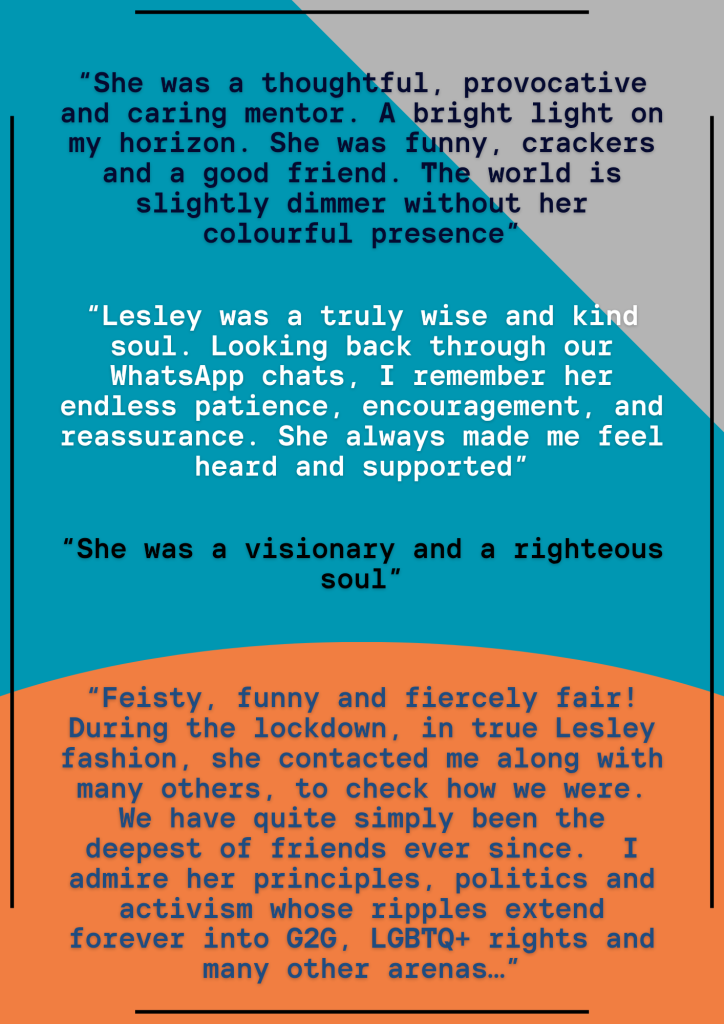
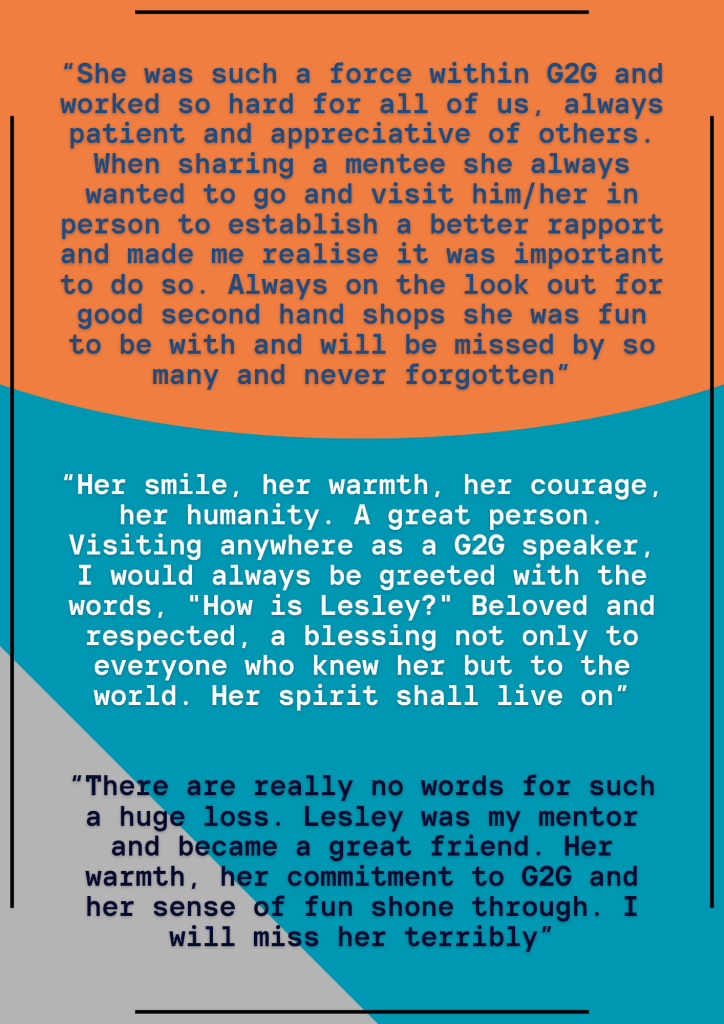
Messages of Condolence
As part of G2G, Lesley had a unique relationship with these organisations
It was with great sadness that I heard of the passing of Lesley. She was a wonderful, friendly, warm-hearted and insightful person. We began working with Lesley last year on a project that compared Holocaust survivor testimony through the next generation on coming to the UK from Europe, with testimony on modern day refugees. Lesley was so passionate about this project and understood totally the value of comparing and contrasting these experiences. The last time I saw Lesley was at the celebration of Finchley Progressive Synagogue receiving Synagogue of Sanctuary award – and she was so happy to be there. She will be missed by so many who valued her wisdom, and by myself and Yael Peleg from my team were so privileged to have got to know her.
May her memory be for a blessing.
Rabbi David Mason, HIAS+JCORE

I first met Lesley around ten years ago when she approached me, as Director of René Cassin, to introduce me to the newly formed G2G. What began as a professional connection quickly grew into a deep friendship that I treasured, both personally and professionally.
Lesley was one of those rare people whose energy, creativity and warmth brought people together. Over the years, René Cassin and G2G collaborated on numerous initiatives, many of them inspired by Lesley’s ideas and driven by her genuine commitment to the work that both René Cassin and G2G are guided by – that every person, regardless of their circumstances or immigration status, should be treated with dignity, respect, fairness and kindness.
As our friendship developed, Lesley joined René Cassin’s Fellowship Programme, where she explored her activism through a Jewish human rights lens. And true to who she was and what she believed in, Lesley chose her final project to be on the largely unknown and forgotten trafficking and exploitation of Jewish women, determined, as always, to highlight the injustice caused.
Most recently, Lesley had the inspiring idea for a joint René Cassin-G2G speakers’ series exploring human rights across generations. It was a brilliant idea that brought together historical and contemporary experiences in a way that was engaging, thought-provoking and deeply human. The success of the series owes much to Lesley’s vision and to the care and encouragement she gave to the G2G presenters she mentored.
Lesley’s legacy at René Cassin is not only found in the programmes she helped create or the partnerships she nurtured, but in who she was – a committed activist, a generous collaborator and a deeply compassionate friend.
She will be greatly missed by me personally, by René Cassin and by the continuing vision to create a fairer, kinder, and more just society.
Mia Hasenson-Gross, René Cassin

Lesley Urbach – an appreciation
We had the privilege of knowing and becoming friends with Lesley through working with her. Lesley had a lovely warm personality, was a veritable and vibrant powerhouse of energy and knowledge – and always insisted on the highest of standards. It is a great tragedy that she was cut from life so soon.
Northern Holocaust Education Group (NHEG) was greatly helped and supported in our initial setting up by Lesley and G2G and since then we have continued to work together happily and co-operatively. We have been in awe of what G2G has achieved and Lesley played a huge part in this.
NHEG learnt a huge amount from Lesley and will always be hugely appreciative of all her, and G2G’s, help.
Lesley leaves a big hole but also a wonderful continuing legacy in the work of G2G, and NHEG .
We miss her.
Vivienne and Ernie Hunter, both personally and on behalf of NHEG
Messages of Condolence
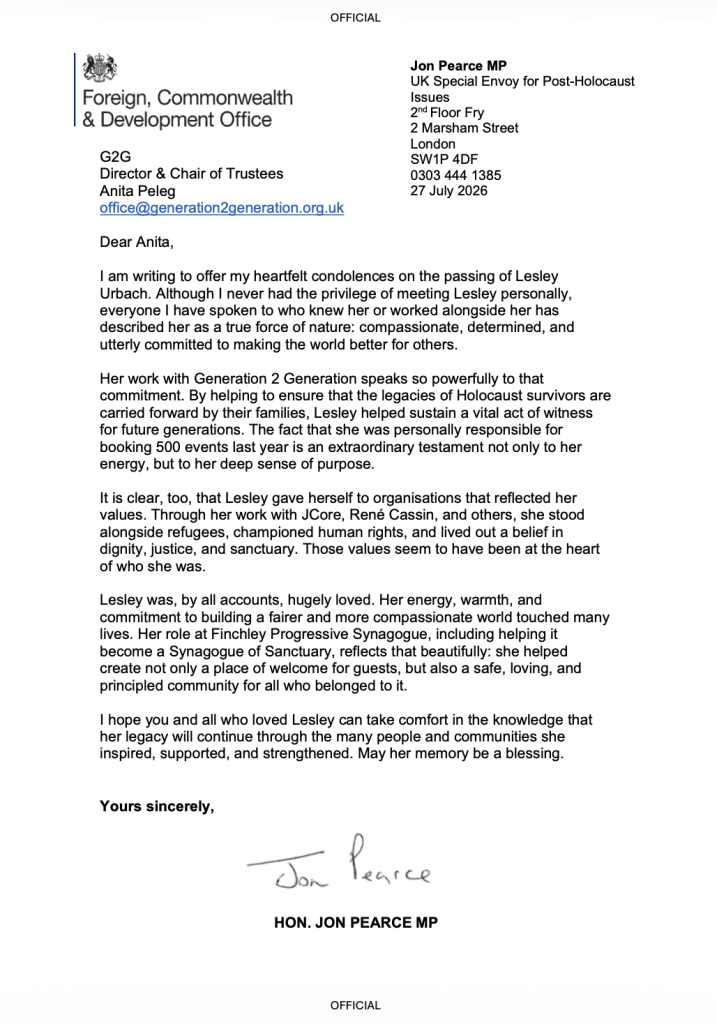
As we go to ‘press’ we have just received this letter
G2G Upcoming Events
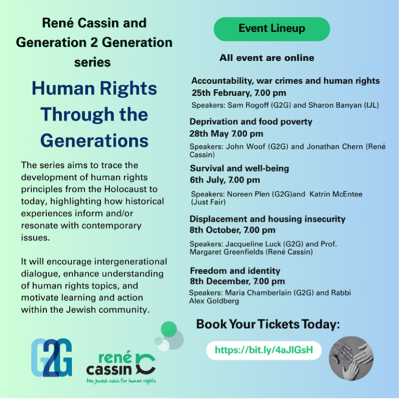
The following collaboration was close to Lesley’s heart.
A joint G2G & Rene Cassin programme of events:
28 May, 6 July, 8 October, 8 December (all online)
Lessons Across Generations
This wide-ranging series aims to trace the development of human rights principles from the Holocaust to today. Click here to book
Partner Events
Association of Jewish Refugees (AJR)
Poland, 11 – 15 October 2026
AJR Heritage Tour of Poland
A four-night heritage tour of Poland. Basing ourselves in Warsaw, we will also visit Łódź, Lublin, Treblinka and Tykocin led by expert guides and educators. Click here to book
The AJR has launched its new digital home for Holocaust refugees and survivors, their families and future generations; and a valuable resource for researchers, educators, the media, supporters, volunteers and donors, and so much more.
Visit the new AJR website now – www.ajr.org.uk
JW3
Thursday 16 July 19:00-20:15 (in building. Age 13+)
Football in Mauthausen: Memory, Testimony and Responsibility
What does football reveal about life, power and survival in a concentration camp?
Explore the little-known history of football in and around Mauthausen concentration camp, from the teams and matches connected to the SS, to the ways in which football also became part of prisoners’ daily reality. A discussion with Bernhard Kolbe from the Mauthausen Memorial, and survivor Eva Clarke, who was born in Mauthausen in April 1945, just days before liberation. Tickets £15. Click here to book
National Holocaust Centre and Museum
‘Meet the Holocaust Survivor’series – all in building
Thursday 30 July 13:00-14:30
Agnes Kaposi MBE
Born in Hungary in 1932, Agnes was still a child when her life was shaped by persecution, forced labour and displacement under Nazi rule.
Ticket prices vary. Click here to book
Tuesday 4 August 13:00–14:30
Steven Frank BEM
Amsterdam-born Steven experienced both Westerbork and Theresienstadt. Ticket prices vary. Click here to book
| Thursday 6 August 13:00–14:30 Joan Salter MBE Joan was born in 1940 in Belgium, to Polish parents, and escaped to Paris and then the Spanish border. Ticket prices vary. Click here to book |
| Monday 10 August 13:00–14:30 Hedi Argent MBE Hedi lived in, and escaped, from Nazi-occupied Austria.Ticket prices vary. Click here to book |
| Tuesday 18 August 13:00–14:30 John Hajdu MBE John was born in Budapest in 1937 and survived the war there in great danger. Ticket prices vary. Click here to book |
| Monday 24 August 13:00–14:30 John Fieldsend BEM Born in Czechoslovakia in 1931, John came to England on the Kindertransport. Ticket prices vary. Click here to book |
| Thursday 27 August 13:00–14:30 Ruth Barnett MBE Ruth escaped from Berlin in 1939 on the Kindertransport, aged four. Ticket prices vary. Click here to book |
Wiener Holocaust Library
Until 30 September
Life and death in Saharan Vichy labour camps
Nazi-run labour camps in Algeria and Morocco were operated by the Vichy French authorities from 1940 until November 1942. This exhibition sheds light on these lesser-known forced labour camps in the Sahara.
Free. For more information click here
Until 30 October
Nazi Slave Labour: Perpetrators and Victims
Between 1939 and 1945, 20 million individuals were exploited as slave and forced labourers by the Nazi regime. This exhibition will explore how perpetrators profited off and exploited slave labourers, alongside the first-hand stories of the victims. Free. For more information click here
Have you enjoyed our Newsletter? Please consider making a donation to our charity.
Your donations help us to keep experiences of the Holocaust alive and teach younger generations the importance of inclusivity and empathy. You can donate to support our ongoing work in the following areas:
- Speaker development and training
- Technical support for our speakers
- Creation and writing of educational materials
- Provision of Holocaust speakers for schools and other organisations
- Raising awareness of our work and our message.