
Newsletter for Generation 2 Generation

March 2026 | Adar – Nissan 5786

We deeply appreciate your support. Please share this newsletter with those who believe in our mission of Holocaust education and remembrance. Your efforts help us ensure that the lessons of history are never forgotten. Thank you.
Has this newsletter been forwarded to you? You can sign up by clicking here.
Editorial
Continuing January’s Holocaust Memorial Day theme of ‘Bridging Generations’, this month we look at the challenges and opportunities for Holocaust educators. Teachers, whether in schools or in the field, are very much tasked with bridging the generations. Their role is not only educational, but ethical. They need ensure that their students learn about the Holocaust, but also from the Holocaust. As the Shoah recedes in time – the centenary of its inception is not that far off – it becomes harder to differentiate it from any other ‘long ago’ period of history.
We have already begun to see the conscription of AI in the drive to make Holocaust education relevant and meaningful to today’s younger generations. Virtual Reality (VR) feels like it can transport its viewers personally to a given place and time in a way that books or even videos cannot. Generation 2 Generation’s unique contribution is to offer the testimony of survivors via the lived experience of their close descendants. Below, we publish articles by two other practitioners. Here in the UK, Joanna Clarke has developed a pioneering approach to Holocaust education within her own secondary school. And Susanne Seitz writes of educating German children on the legacy of the Nazi genocide in situ in Bergen Belsen. Different audiences, different national histories, but similar challenges.
Vivienne Cato
G2G Upcoming Events
Monday 16 March 19:30 (online)
Joan Noble presents: The Story of Liesel Katz
Using excerpts from her mother’s 1933 teenage diary, Joan Noble tells us why and how her mother, Liesel Katz, left Germany in 1938 and what happened to her parents who were left behind in Germany. Book tickets here.

G2G News
Collaborations and partnerships are at the heart of G2G’s success. We work closely with several organisations that refer our speakers, promote our work and give us invaluable advice. We recently announced a fruitful partnership with Holocaust Learning UK working on referrals and joint events for schools. We are now pleased to announce two meaningful event collaborations.
G2G with HIAS +JCore
G2G will be working with HIAS +JCore, the UK Jewish charity which supports and advocates for refugees and asylum seekers.
Together we are creating a series of events that brings G2G speakers and present-day refugees together to talk about their personal and family experiences as refugees.
Then and Now: The changing experience of refugees will look at how refugee experiences have changed over the decades and what parallels remain. Led by Executive Director of HIAS +JCORE, Rabbi David Mason, these panel discussions promise to be a unique opportunity to explore connections between people’s journeys towards rebuilding in the UK.
G2G and René Cassin
For several years G2G has successfully partnered with René Cassin, the Jewish voice for human rights in the UK. This year we will continue that partnership with a new series:
Human Rights through the Generations will trace the development of human rights principles from the Holocaust to today, highlighting how historical experiences inform and/or resonate with contemporary issues.
Events will feature G2G speakers and human rights experts in conversation with Mia Hasenson-Gross, René Cassin’s Executive Director. The series will encourage intergenerational dialogue, enhance understanding of human rights topics, such as war crimes, food poverty and displacement, and motivate learning and action with the Jewish community.
For more information click here.
Features
Routes into teaching the Holocaust
Joanna Clarke
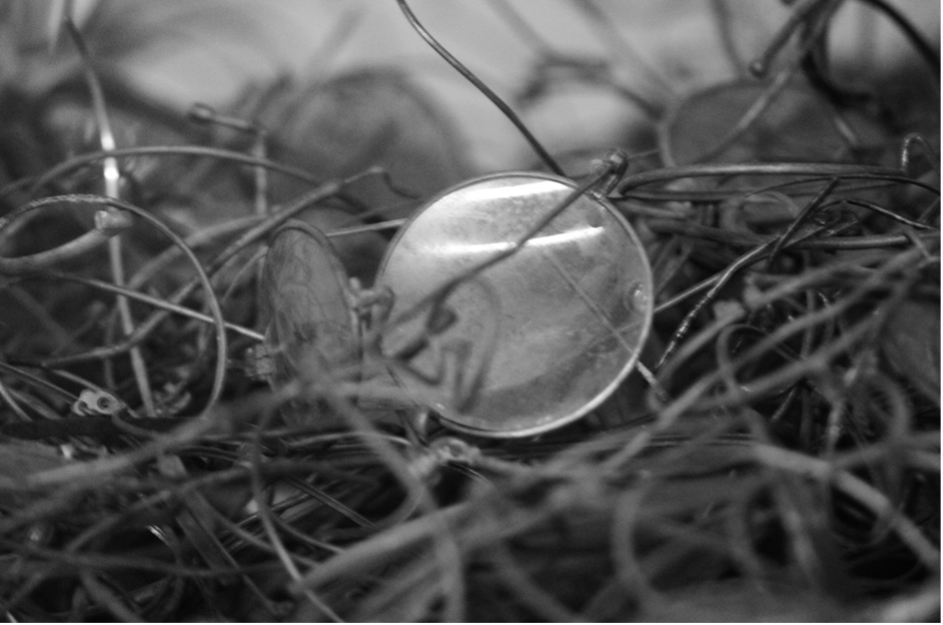
When I was at school the Holocaust was a living piece of history, and we never studied it directly. It was taken for granted that we knew about its historic and humanitarian importance because we had direct contact with the generation who had lived through its horror. That connection can no longer be taken for granted. We are the last generation of people who have the opportunity to try to relate to the firsthand experience of survivors in our lifetime. My endeavour as a teacher is to find a way to perpetuate the precious thread of our collective memory about the Holocaust, because that is what the essence of history is – the study of humanity.
Importance of reclaiming the narrative
If I as a teacher showed students a row of corpses taken by a Nazi as a glory shot, was I somehow complicit in their dehumanising of these individuals? How could I get students to fully imagine the lives of Jewish individuals if I only showed them as victims? An essential part of my Holocaust education has been discussing with students who is in control of the narrative – who is taking the photo, creating the drawing, writing the record? There are photographs taken secretly and now exhibited at Auschwitz that show these same brutal events, but the images have a different meaning as they symbolise an act of resistance.
Context is king
How could I expect students to truly engage with the deliberate murder of six million Jews, if they had no knowledge of these people’s lives and culture in the years before? I began to look for individuals whose lives we could track before the start of the Second World War so that we could learn more about Jewish culture and the impact of gradual persecution during the 1930s. A couple of years ago I was introduced to the story of Frank Bright from Berlin at a teaching conference. Frank was one of nine out of a class of 38 to have survived. Now when my year 9 class begins their study of the Holocaust I am able to put his class photo on the board and give each student a Yad Vashem document which give details of each of his classmates.
Individual and diverse experiences are key
Taking sixth-form trips to Auschwitz has come to be the single most important school trip I have ever run. I wish all teenagers had the opportunity. Here is one recent memory from one of my students: ‘We were privileged to spend an afternoon with Lidia Maksymowicz, who was in Auschwitz as a toddler. Her only memory of her mother was the hands that gave her stolen food. When adopted at the end of the war – she said she would only go with her new parents if there were “No dogs, no rats and no Doctor Mengele”. As she rolled up her sleeves to show us her camp tattoo, it was almost unbearable to imagine her alone in a barracks at the age of only 3.’
Forging community connections to perpetuate the collective memory of the Holocaust
I wanted our students who had gone on this trip to engage more widely with our school community so that they could start to become educators on the Holocaust. Sixth form historians led tutorials with younger students fielding their questions about the Holocaust and sharing their experiences of visiting Poland firsthand. We also involved the parental body, by sharing watching, listening and reading recommendations from our department, and asking anyone if they had their own personal stories to share.
The value of the documents and importance of engaging critically with the Holocaust
For a teacher, the Holocaust presents unique challenges. It is impossible to engage dispassionately with the documents in a way that you might do when studying the Tudors. But it is still important that students engage with the Holocaust in a scholarly and critical way, as well as developing an awareness of how the history of this period has been made. We get our A-level students to read the most up-to-date scholarship from living historians like Hoyer, Evans and Kershaw as well as delve into the archives to create their own interpretation of why they think the Holocaust happened. Every year new interpretations and source material on this period are emerging. Primary sources from the time can speak with a voice as compelling as a living firsthand account of the Holocaust. The wealth of documents available to us ensure that teachers can continue to engage and enrich the next generation’s understanding of the Holocaust.
The fragility of memory
I try to make my students aware that there are multiple narratives of the past and that personal memory is fragile and often unpredictable. It is not a given that important events will be remembered, or be remembered in the same way. Our visit to Poland made students painfully aware of this. I will never forget an experience of one of my students who was almost entirely blind. She was shocked by the guide’s description of photographs in the Galicia Jewish Museum documenting previous places of importance for Poland’s Jewish community. She could not comprehend that where once synagogues had stood, there were now department stores, and car parks. Because Jewish communities had been so thoroughly eliminated from some villages and towns, there was no one left to memorialise what these places had originally been.
Conclusion
I was hugely moved to hear Otto Frank’s reflection that he hadn’t really known large parts of his daughter until after her diary was uncovered when visiting Anne Frank’s house. In some way her personal thoughts gave him an enduring connection with his own daughter that he never had during her lifetime. We fear that as time elapses, we will gradually be able to learn less and less about the past. Yet what this example shows to us is that a father was able to use his daughter’s writings to know her more deeply. This for me is the essence of why we study history. We do not tend to learn from the past. The striving for truth in an interpretative discipline is deeply problematic. Rather as we get further in time from the events of the Holocaust, I hope that we can educate and empower the future generation to use the wealth of documents, interpretations and diverse personal stories to come closer to what it means to be human.
Joanna Clarke is Head of History at Hurstpierpoint College in West Sussex
Educational work at the Bergen-Belsen Memorial in Germany
Susanne Seitz
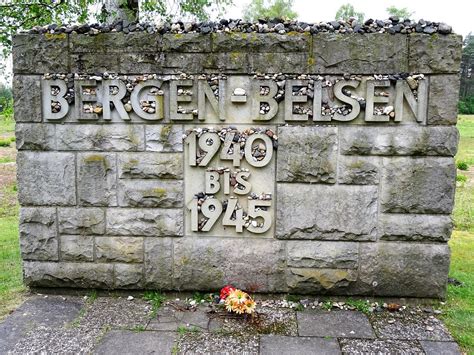
In 2006 I started guiding schoolchildren at Bergen-Belsen. At that time we were a group of eight teachers from different kinds of schools who were sent to the memorial for one or two days a week. In addition to us, a few educators and students worked there on a freelance basis. Since then, the educational work has been expanded by growing numbers of permanently employed historians. Our database of media such as text sources, photos and eyewitness accounts of the concentration camp and the DP camp is constantly growing, too.
Nowadays a new generation is visiting the memorial. Only their great-grandparents experienced the Nazi era and could, if at all, tell stories about it. In general it is no longer part of a conscious family history and the ‘common knowledge’ about the years 1933-45 is vanishing. In addition there is a bigger variety of cultures in German schools and there are more students who have never heard about Nazi Germany. Thus, our profound media database plus the impressive exhibition are very helpful tools in providing the necessary information.
Teachers can choose between a three-and-a-half to five-hour guided tour or a six-hour workshop for their groups. In this article I focus on the shorter guided tour of 240 minutes.
As you can imagine, every teacher has their own method and style, and I am mainly talking about my own experiences. Other guides’ reports would vary, but we all share the aim of getting the students interested in the topic and providing them with information to enable them to resist the influence of hate speech and racism. And I am sure we all point out survivors’ messages such as ‘You are not guilty; you are not responsible for what has happened in the past; but we are all responsible for what is happening now!’
I: Introduction
We usually start in a room with information about the camp’s history. There is a variety of maps, PowerPoint demos, photos, diaries, and artefacts found on the camp site. After an hour or so, a short break then leads into…
II: A walk across the former concentration camp site
There are no buildings or huts left at Bergen-Belsen, only some excavations; but with diary excerpts or former prisoners’ drawings we can try to convey an impression of what happened at, say, a latrine, a kitchen or the rollcall area. Most colleagues now continue their walk to the cemetery area, but my next step is…
III. Visiting the exhibition
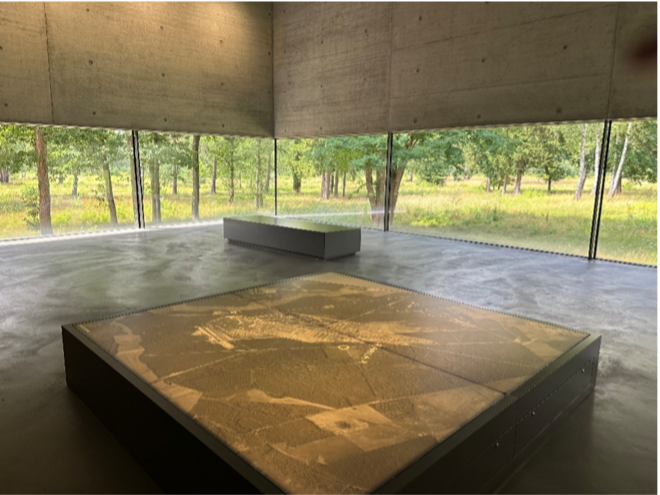
The exhibition consists of photos and films of the liberation and the DP Camp, and excerpts of survivor interviews carried out by Bergen-Belsen Memorial.
I prefer to introduce the exhibition by focussing on one single eyewitness and therefore we watch a seven-minute interview in a separate room without being distracted by other visitors. The students concentrate on the experiences of that one person and afterwards there is time for further explanations and for the students to ask clarifying questions, to express their opinions and to process new understandings such as survivors’ guilt, the absolutely uncertain future, the loss of family, of language, of home, of faith…
After time for reflection and insights into this new and broader context the students visit the exhibition on their own, following their individual choices. This generally means that students do not run from one exhibit to the next, hardly taking anything in before moving on.
Having visited the exhibition, hopefully having learnt more about the former camp and having seen photos of victims being thrown into mass graves it’s time to go out to…
IV. The cemetery
At the first mass grave we usually stop and read the inscription HIER RUHEN 2500 TOTE – APRIL 1945 [Here Rest 2400 Dead]. To the frequently asked question ‘Are they still in there?’, the answer ‘Yes!’ has a great impact. Maybe it’s because this is a different medium: it really exists and is touchable. All the atrocities we have just heard about, they happened right here! Anonymous innocent men, women and children of different religions and various nationalities were thrown into these pits; and when we move on to the tombstones they can understand that these stones are one way for relatives to honour their ancestors by putting up a stone by the engraved name – even though, of course, there is no body buried beneath. They are just memorials.
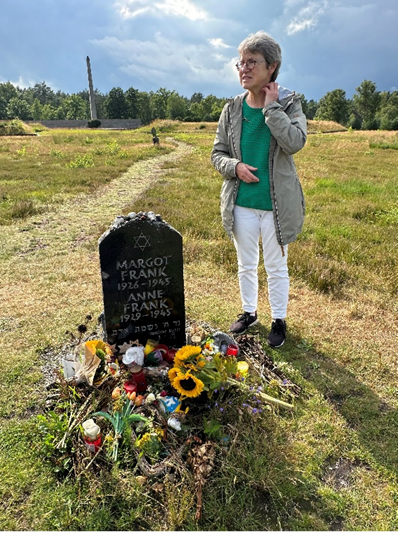
The stone commemorating Anne and Margot Frank cannot be overlooked because of the numerous devotional objects in front of it like flowers, candles, letters, coins, necklaces, key rings, teddy-bears and much more. Some of the gifts have obviously been prepared at home, others laid down spontaneously. But every donation indicates that visitors, young and old, feel the need to DO something, to express their emotions of mourning actively.
Asked which mourning rituals they know, the students name things like prayers, candles, minutes of silence; and I invite them to go to the adjacent House of Silence together. We tell them it is voluntary; there is no door, and you are free to leave at any time should you feel uneasy or embarrassed. In most cases the whole group moves inside, and they are absolutely silent for one minute, often longer. In this semi-open space for contemplation they can sit down and listen to a short poem written in the camp by a Polish prisoner. Silence and reflection on the day’s impressions then follows.
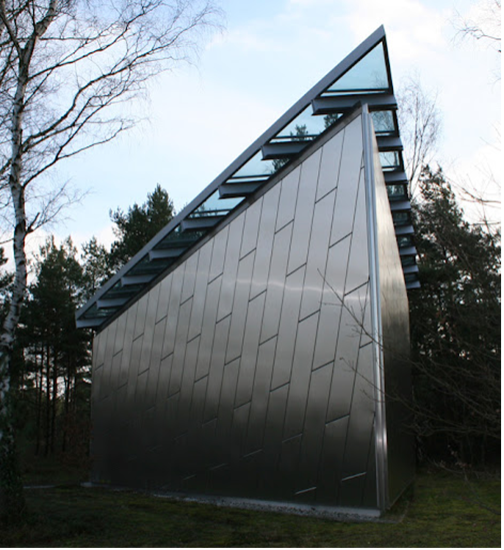
Then we gather in a circle, and they have the option to light a candle and give feedback. Some reflections have been:
- It’s like saying good-bye to this place
- Thanks that we could light a candle
- For me this was the most important part of the day
- This made the difference between visiting a museum and a memorial (a teacher)
The job of educators at Bergen-Belsen here on the former Camp site is probably easier than it is for G2G presenters. We are often told ‘We have learned about the Holocaust at school but being at this site is a completely different experience.’ It is possible that some student visitors are hostile, or indifferent to the fate of the Nazis’ victims – but in our experience this has not been expressed, or at least has been consciously withheld.
Susanne Seitz, a Secondary Modern schoolteacher, guided tours and seminars at Bergen Belsen between 2006 and 2015. She now is a freelance guide for students or individual guests.
Partner Events
Association of Jewish Refugees (AJR)
Facing History and Ourselves
Monday 16 March 23:00-00:15 GMT (online)
Echoes of the Holocaust: Strengthening Memory with Holocaust Literature
Spotlighting the new Teaching Holocaust Literature collection, participants will consider how integrating literature of the Holocaust can strengthen Holocaust memory and teach valuable lessons about our world today.
Free. Click here to book
JW3
Sunday 22 March (online) 11:00-12:30
Being Second Generation
Over 80 years after the Holocaust, children of survivors and refugees will explore together how it has affected their lives.
£15. Click here to book
Monday 30 March 19:00-20:15 (in building)
Dreaming and Resisting: What We Know and What We Deny
Drawing on Beradt’s extraordinary archive of dreams collected in 1930s Nazi Germany, filmmaker and journalist Amanda Rubin, psychotherapist Robin Shohet, and dream researcher Melinda Powell will explore what our dreams reveal about our values, our fears, and our ability to stand up to injustice.
£15. Click here to book
The National Holocaust Centre and Museum
Sunday 15 March 11:00-13:00 (in building)
Mothers of the Kindertransport
This Mothering Sunday will feature a powerful talk exploring the often-overlooked stories of the left-behind mothers of the Kindertransport. Curator Dr Claudia Reese will reveal rare and fragile artefacts, including Anni Druckmann’s farewell letter to her daughter.
Ticket prices vary. Click here to book
Wiener Holocaust Library
Exhibition
Until 30 April
Eldercide: Older Jews and the Holocaust
The untold story of elderly Jews during and after the Holocaust. Co-curated with Professor Dan Stone of Holocaust Research Institute, Royal Holloway, University of London. Free. For further information click here
Events
Tuesday 3 March 18:30-20:00 (in building and online)
Book Talk: The Unspeakable by Nicola Hanefeld
Cousins Nicola Hanefeld and Julia Waring discuss a new work exploring Holocaust family history research, The Unspeakable: Breaking my Family’s Silence surrounding the Holocaust. They will recount their moving and thought-provoking journeys as they broke their family’s long silence about the past. In collaboration with the Second Generation Network. Free. Click here to book
Wednesday 11 March 17:00-18:30 (in building)
Book Launch: The Long Death of Adolf Hitler: An Investigative History
Caroline Sharples’s new book constitutes the first cultural history exploration of Hitler’s fate, setting out how the Nazi dictator’s demise was anticipated by Allied audiences during the Second World War, mourned by loyal National Socialists in 1945, and reimagined in postwar popular culture. Caroline is Senior Lecturer in History at the University of Roehampton with research interests focussed on the aftermath of National Socialism. Free. Click here to book
Thursday 19 March 17:00-18.30 (in building)
Book Launch – Older Jews and the Holocaust: Persecution, Displacement, and Survival
How did older German and Austrian Jews experience the Holocaust? What do we know about care for older and aging survivors immediately after the Holocaust? How has this history informed the efforts of the Claims Conference on behalf of Jewish Holocaust survivors over the years? The volume editors and contributors, all Holocaust historians, will discuss these and other questions at the launch of their groundbreaking book. Speakers will be Dr Elizabeth Anthony, Dr Michael Geheran, Dr Joanna Sliwa, Chen Yurista, and Dr Christine Schmidt, Acting Co-Director of The Wiener Holocaust Library. Free. Click here to book
Wednesday 25 March 18:30-20:00 (in building)
Book Talk – Concentration Camps: A Global History. Alan Kramer in conversation with Dan Stone
The Holocaust and Genocide Research Partnership hosts Professor Alan Kramer in conversation with Professor Dan Stone about Professor Kramer’s new book: Concentration Camps: A Global History. Why were concentration camps created? In popular perception concentration camps are synonymous with genocide—racial extermination. Yet the great majority were not sites of genocide, nor were they a Nazi invention. Alan Kramer provides a comprehensive history of concentration camps, from the beginning of the twentieth century to their continued use today. Free. Click here to book
Holocaust Educational Trust
Calling all teachers!
The Holocaust Educational Trust’s Lessons from Auschwitz CPD for Teachers is a three-part course combining educational theory, a historical site visit and practical pedagogy for teachers of KS3-5 from state schools in England. Open to both practising or trainee teachers of History, RE, English, Citizenship, or any other subject, this experience will equip teachers with the knowledge and confidence to approach Holocaust education effectively.
Further details including the application form can be found here https://www.het.org.uk/lfa-cpd.
Volunteers needed for a survey
If you are Second Generation (2G) and willing to spare 15-20 minutes for a survey, Nicola Keller would like to hear from you. ‘I am a PhD student at Cardiff University, second-generation myself and I hold a family archive at The Wiener Holocaust Library. I am researching how language might affect decisions 2G make around their family Holocaust documents and artefacts. I will be asking brief, non-identifying questions about parents’ wartime experiences, and more detailed questions on family languages, translation of documents (or not) and thoughts about donating to an archive or museum. If you can spare 15-20 minutes to take this survey, please click here for the form.If you have any questions, or problems accessing the form, you can contact me at KellerNC@cardiff.ac.uk .I am interested in hearing from anyone, whether you hold a single item or a suitcaseful.’
Have you enjoyed our Newsletter? Please consider making a donation to our charity.
Your donations help us to keep experiences of the Holocaust alive and teach younger generations the importance of inclusivity and empathy. You can donate to support our ongoing work in the following areas:
- Speaker development and training
- Technical support for our speakers
- Creation and writing of educational materials
- Provision of Holocaust speakers for schools and other organisations
- Raising awareness of our work and our message.